

Astrological Analyses of the Artemis II Mission. As a prelude to Uranus entering Gemini: the first manned lunar mission since 1972
/Related Articles: Uranus Transits and the Eras of Fascism 1917-45 and Neo-Fascism 2001-29, Löwe plus Schütze – zur Astrologie von Raumstationen, The Temple of Artemis at Ephesos in astrology, Die ersten Mondlandungen aus astrologischerSicht, The Space Shuttle “Challenger” Disaster,
Astrological Analyses of the Artemis II Mission
Article: Uranus Transit in Gemini 2025-33
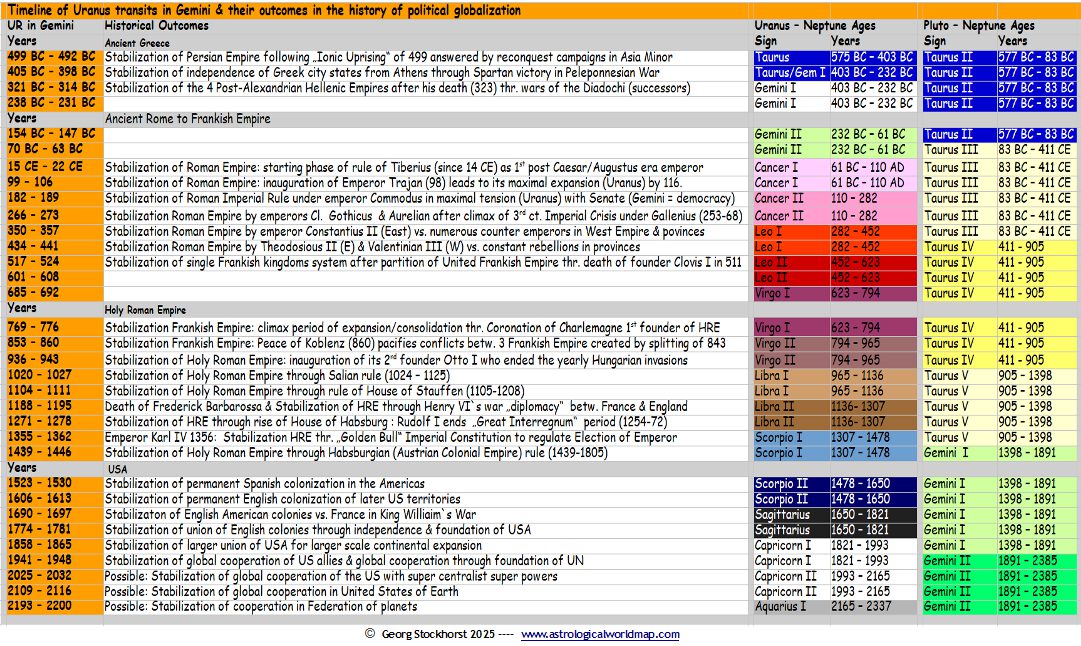
Uranus in Gemini
The horoscope for the rocket launch
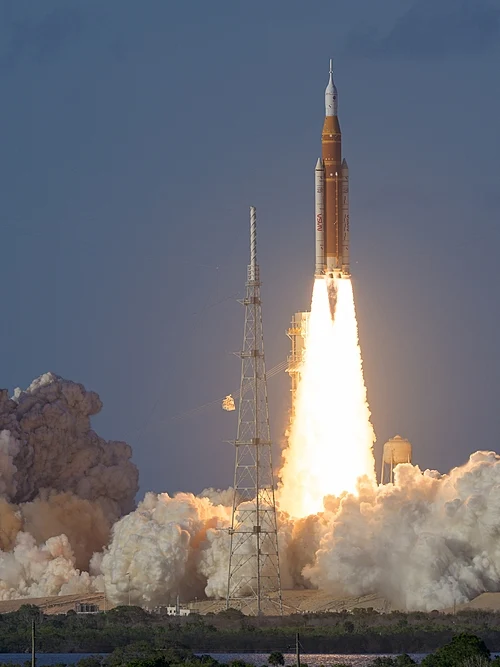
On board were NASA astronauts Reid Wiseman, Victor Glover, and Christina Koch, and Jeremy Hansen from the Canadian Space Agency. It was the first crewed US mission since Apollo 17, which flew from December 7-19, 1972, and was the sixth and last human lunar landing mission.
During the Artemis 2 flight, the four astronauts will orbit the moon in an Orion spacecraft to test the systems and procedures on board before a new lunar landing mission in the coming years.
Trajectory
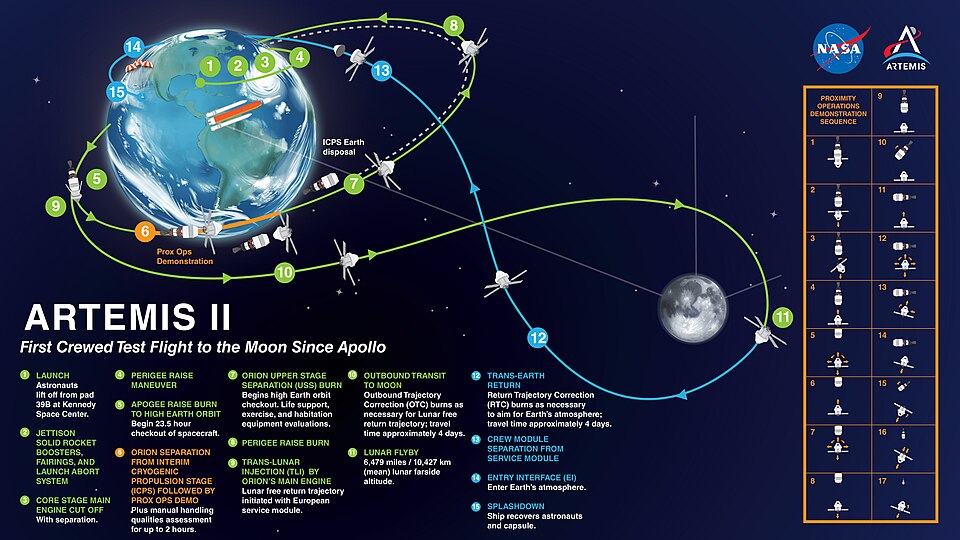
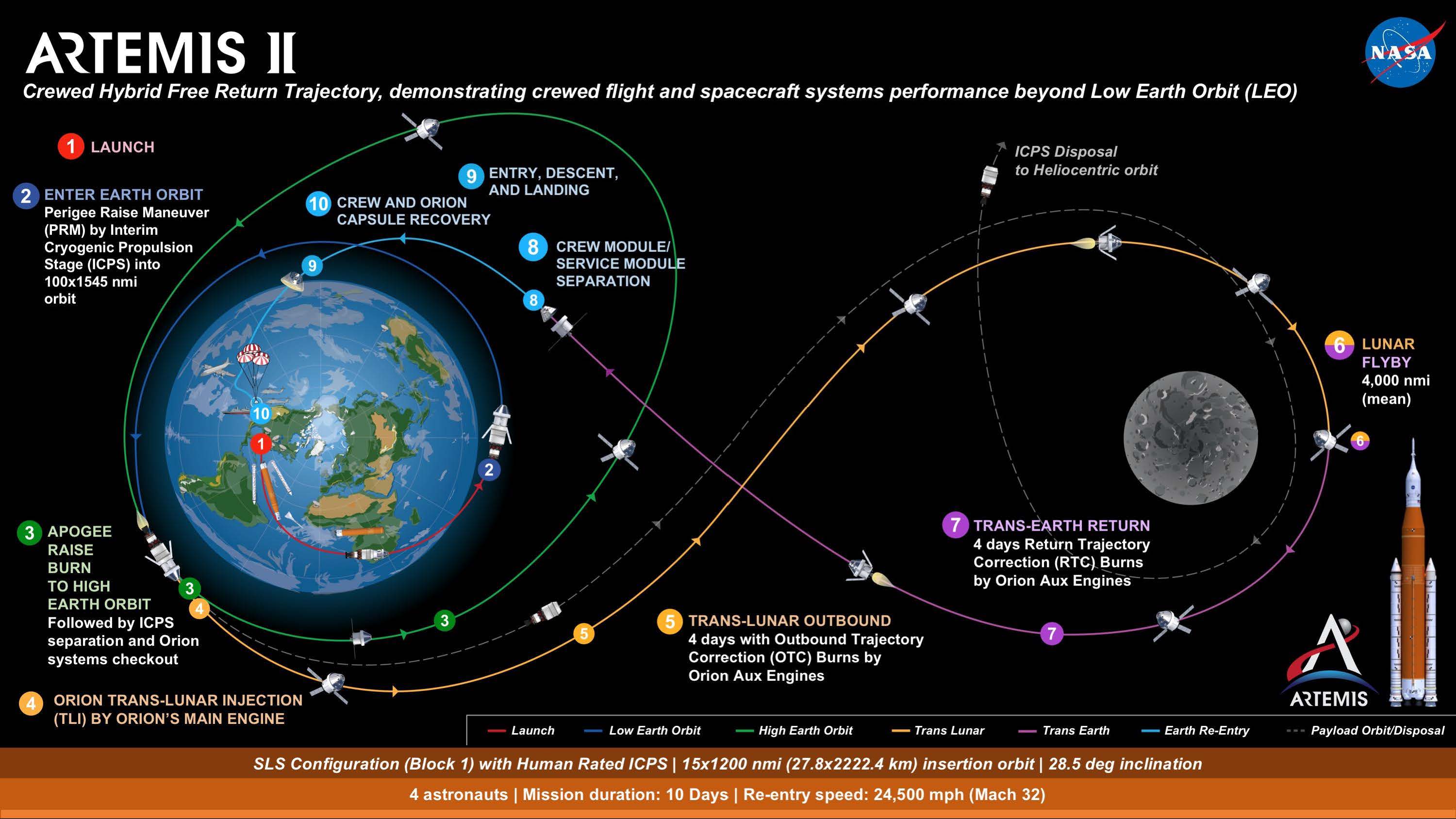
“After launch, the functionality of the Orion life support systems was initially tested in a low Earth orbit. After two orbits, the second stage of the SLS raised the orbital apogee to approximately 71,000 kilometers. In this highly elliptical orbit, Orion is scheduled to separate from the rocket stage, after which the crew will practice manual maneuvers with the spacecraft. About 25 hours after launch, it is expected to perform a translunar injection under its own power, accelerating into an orbit that passes close to and around the Moon. The journey to the Moon is scheduled to take four days, with another four days planned for the return flight. Finally, the Orion capsule is expected to separate from its service module—the propulsion and service unit built by Airbus Defence and Space in Bremen—and splash down in the Pacific Ocean, where it and the astronauts will be recovered with the assistance of the U.S. Navy.” (ccbysa4.0 from Wikipedia article)
Chart details for the Rocket launch
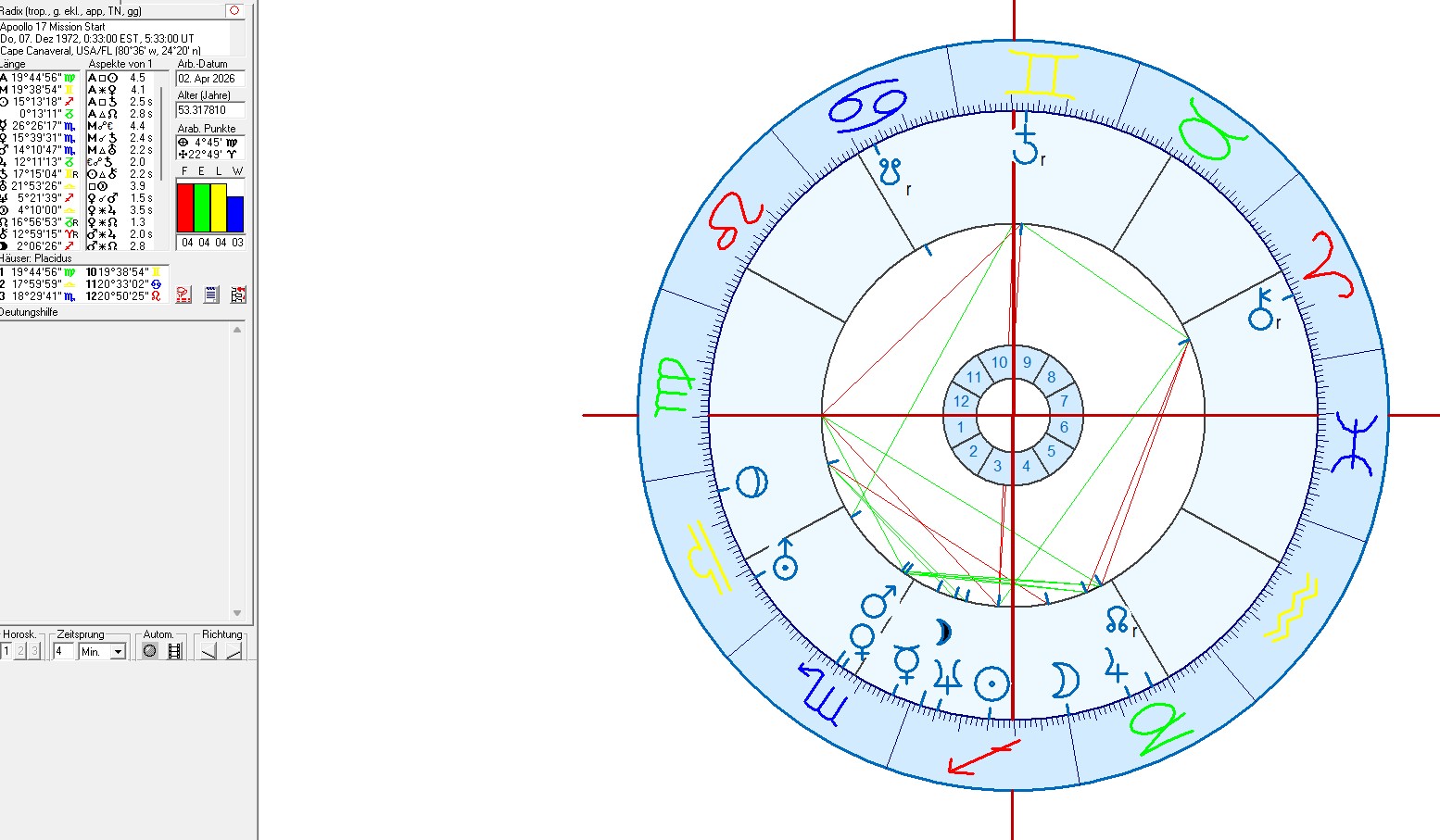
- To interpret this truly spectacular full moon horoscope, it’s important to understand that the initial direction of the launch was oriented towards orbiting the Earth. This is indicated by Jupiter’s position in the 10th house and near the Midheaven (MC).
- Jupiter’s proximity to the MC in the 10th house (the sky above the launch point) is, among other aspects of its significance, an indicator of both the process and the goal of the journey: to begin an orbit around the Earth (Sagittarius aspect of Jupiter) and then to circle the Moon.
- The ruling planet of Jupiter’s position (orbital orientation) in the center of the “Moon sign” Cancer is the Moon itself, which, somewhat surprisingly to me, rose precisely on the eastern horizon.
- The Moon itself, and not even primarily any facets of its use or significance, could be examined astrologically as the theme of the rocket launch. Even if that might sound naive in times of a neo-fascist US government. According to my definition, the scales should also be examined here as an indicator of naive painting, angels, etc.
- All the more so because the ascendant at 12° Libra, among other aspects (including the staged portrayal of the US state cult), represents a sensory “perception mission” (exploration).
- The fact that Venus, as the ascendant ruler, was in the 7th house, the house of the senses, at 3° (2nd subdivision = 2nd house of the sign = Taurus of the Taurus element), in its own sign of Taurus, the sign of matter and gravity, has several levels of meaning:
- A — Since the 7th house is the house opposite the ascendant—that is, the spark and rocket launch—Venus in Taurus, the sign of Earth and its gravity, could be examined as an indication that, during orbits around the Earth, its gravity is used to determine the direction of the trajectory to the Moon and to achieve the necessary speed.
- B — The objective of territorial occupation and profits: this should be seen as a clear indication that the race for the Moon is about preparing future business models and staking out claims and market shares. Venus at 3° Taurus should be examined as a consistent approach to colonization.
- Launch at full moon: In Indian astrology, the saying “one should not travel during a full moon” was a classic tenet. I took this more seriously in the early days of my astrology studies… after all, one tended to follow occultism, or rather, it was unclear whether one could reject it. And I knew too little about the mechanisms of the occult to avoid having to explore it… essentially to test its limits.
- The decision regarding the timing of the Artemis II launch involved calculations of the trajectory – and this would have virtually ruled out astrological selection. Therefore, the task of abstract astrological interpretation would primarily be to examine the overall picture of current events within the horoscope, revealing precisely the timeframe that necessitated this significant and important mission.
- The decision regarding the timing of the Artemis II launch involved calculations of the trajectory – and this would have virtually ruled out astrological selection. A full moon from Earth’s perspective means that the moon is in full sunlight, and the exploration mission is intended to illuminate the moon more fully from Earth’s (Taurus) perspective, considering its markets and material needs.
- Pluto at 5°13′ (3rd subdivision = Gemini = car or airplane) Aquarius: in the 4th house, square Venus at 3° Taurus: here, too, different levels of meaning must be distinguished.
- Pluto (as an indicator of a bunker or container) in Aquarius (in flight & space) in the 4th house could be examined as an indicator of the location, or the safe haven, of the astronauts’ home or living quarters in a spacecraft.
- The square of the spacecraft container to Venus in the sign of Earth’s gravity thus illustrates the suspension of gravity under the conditions of living beings.
- To examine such details more closely, it would certainly be helpful to know more about the horoscope of the last lunar mission
Regarding the astrogeographical position of the “spaceport” Cape Canaveral in the constellation Taurus
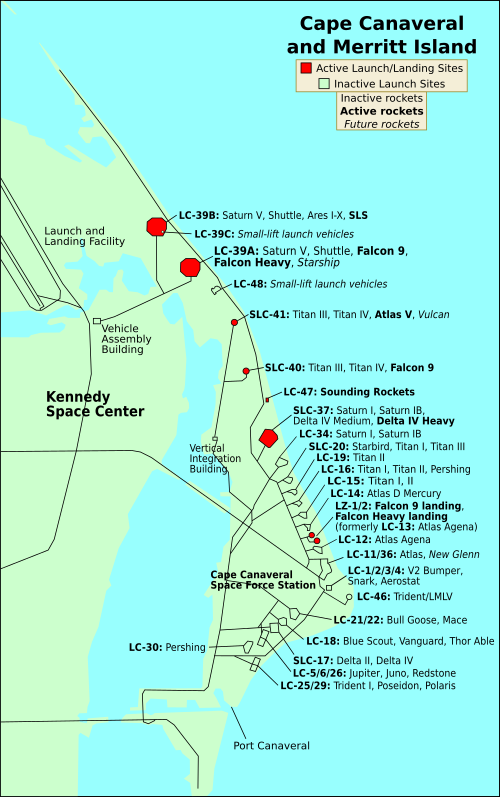
Astrogeographical positions of the “spaceport” Kennedy Space Center in Cape Canaveral
- Field Level 1 (Greater Region, Global Resonance): 22° Taurus – 4° Taurus: Both resonance positions lie within the sign indicator for our home planet Earth, its gravitational pull, and its rootedness in earthly existence, economics, and the terrestrial interests of space travel. From this perspective, Earth would be the gateway to the cosmos—a truly fascinating aspect, especially for this location.
- The fact that this is so explicitly the case, and not the air sign Aquarius (heaven, space, stars, flight, cosmic and galactic dimensions), Gemini (technology development), or the fire sign Sagittarius (navigation, searching, expansion, travel) defining this location, is likely also an indication that journeys into space beyond Earth’s atmosphere are being realized in a real, material, and physical way. And with the goal of practical earthly benefits, profits, or gains for Earth.
- The fact that this is so explicitly the case, and not the air sign Aquarius (heaven, space, stars, flying, cosmic and galactic dimensions), Gemini (technology development), or the fire sign Sagittarius (navigation, searching, expansion, travel), is likely also an indication that travel into space beyond Earth’s atmosphere is being realized in a real, material, and physical way. And with the goal of practical earthly benefits, profits, or gains for Earth.
- A comparable astrogeographical example is the fact that in the third phase of skyscraper development, the tallest buildings on Earth are no longer built in the air signs Aquarius and Gemini, but in the earthly rooted sign of Taurus. See my article: An astrogeographical history of skyscrapers.
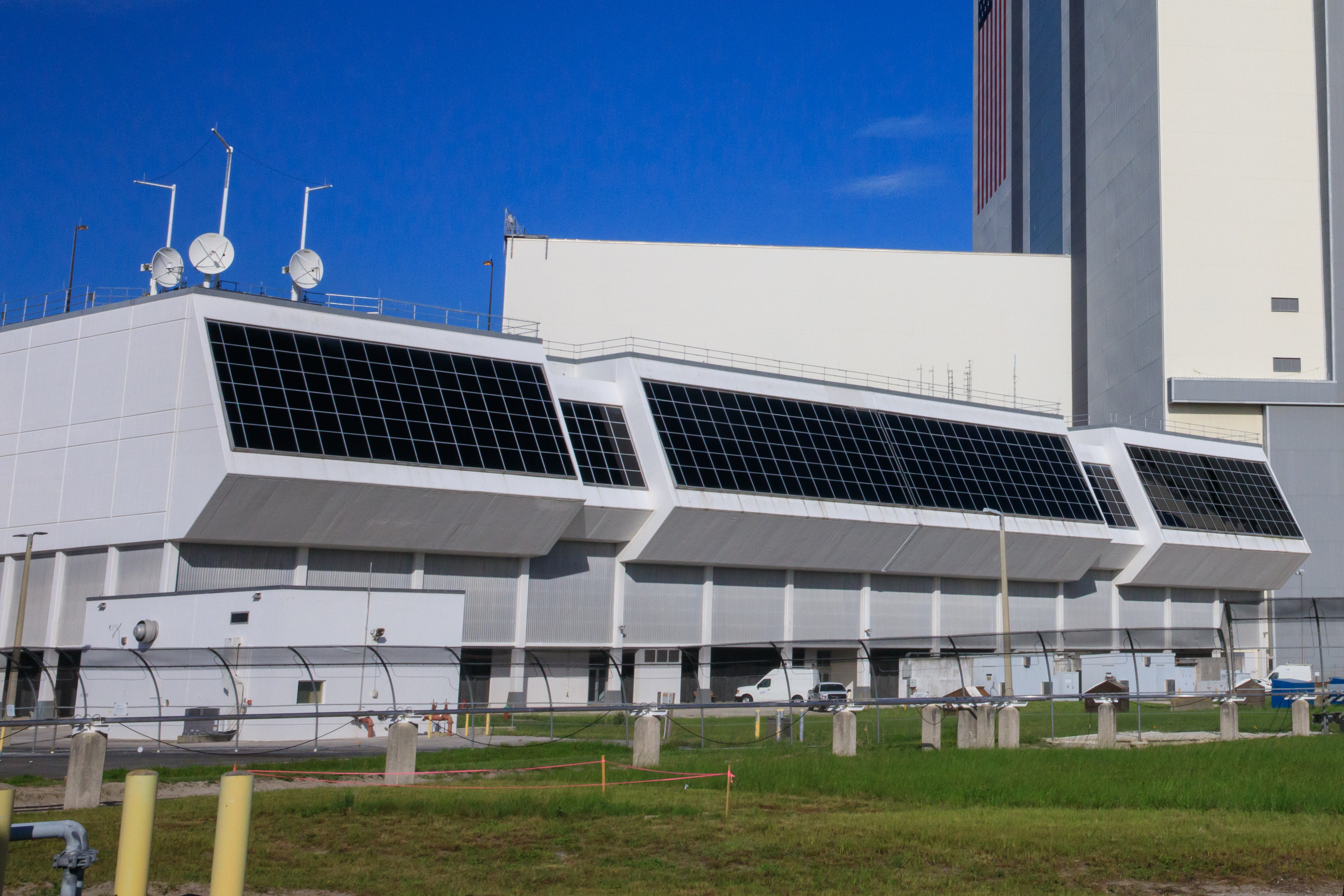
Field level 3 (immediate surroundings) indicates the location quality of the launch control center and the vehicle assembly building: the location lies at the intersection of the two air signs Aquarius and Libra. Libra here represents the responsive, service-oriented functions of launch control. And Aquarius sign of flying, stars and open space represents the focus on vertical launch into the earthly heavens and beyond.
For comparison: The horoscope for the launch of the Apollo 17 mission on December 7, 1972
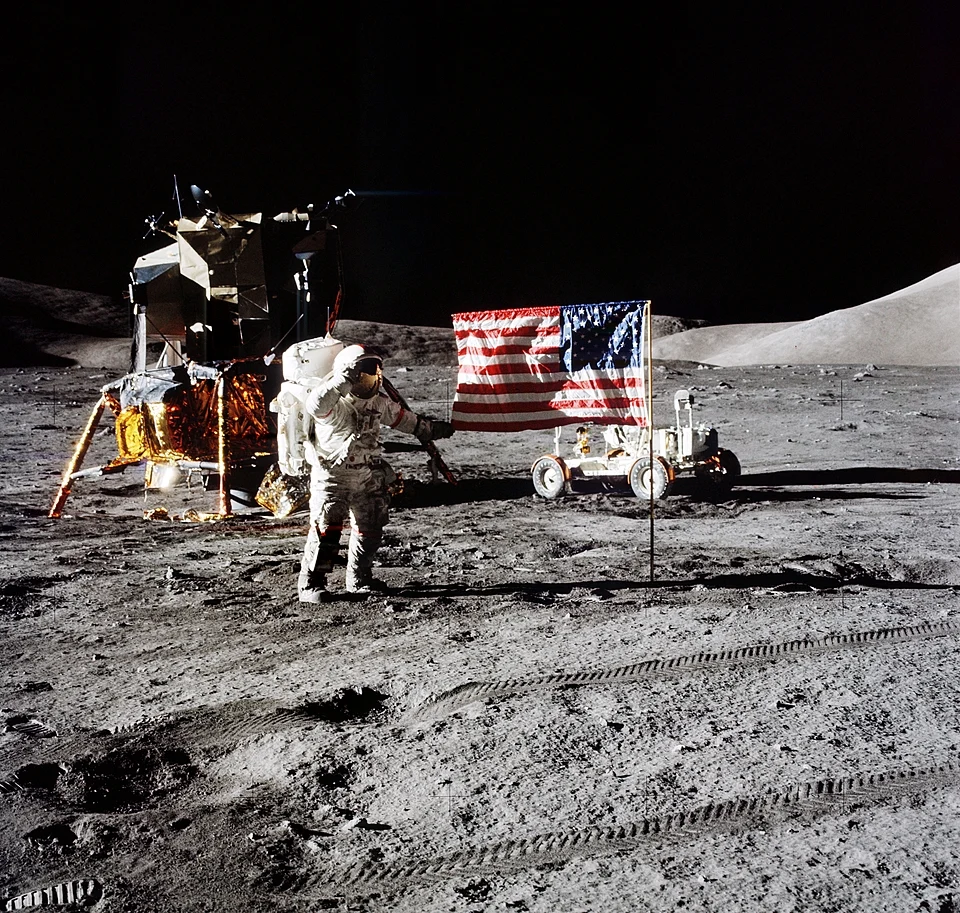
Apollo 17 was the final mission of the Apollo program and the last manned mission to the Moon. On board were Commander Eugene Cernan (born March 14, 1934, in Chicago, Illinois), Apollo spacecraft pilot Ron Evans (born November 10, 1933, in St. Francis, Kansas), and lunar module pilot Harrison “Jack” Schmit (born July 3, 1935, in St. Rita, NM).
The lunar landing was successful on December 11, 1972, at 7:54:57 PM UT.
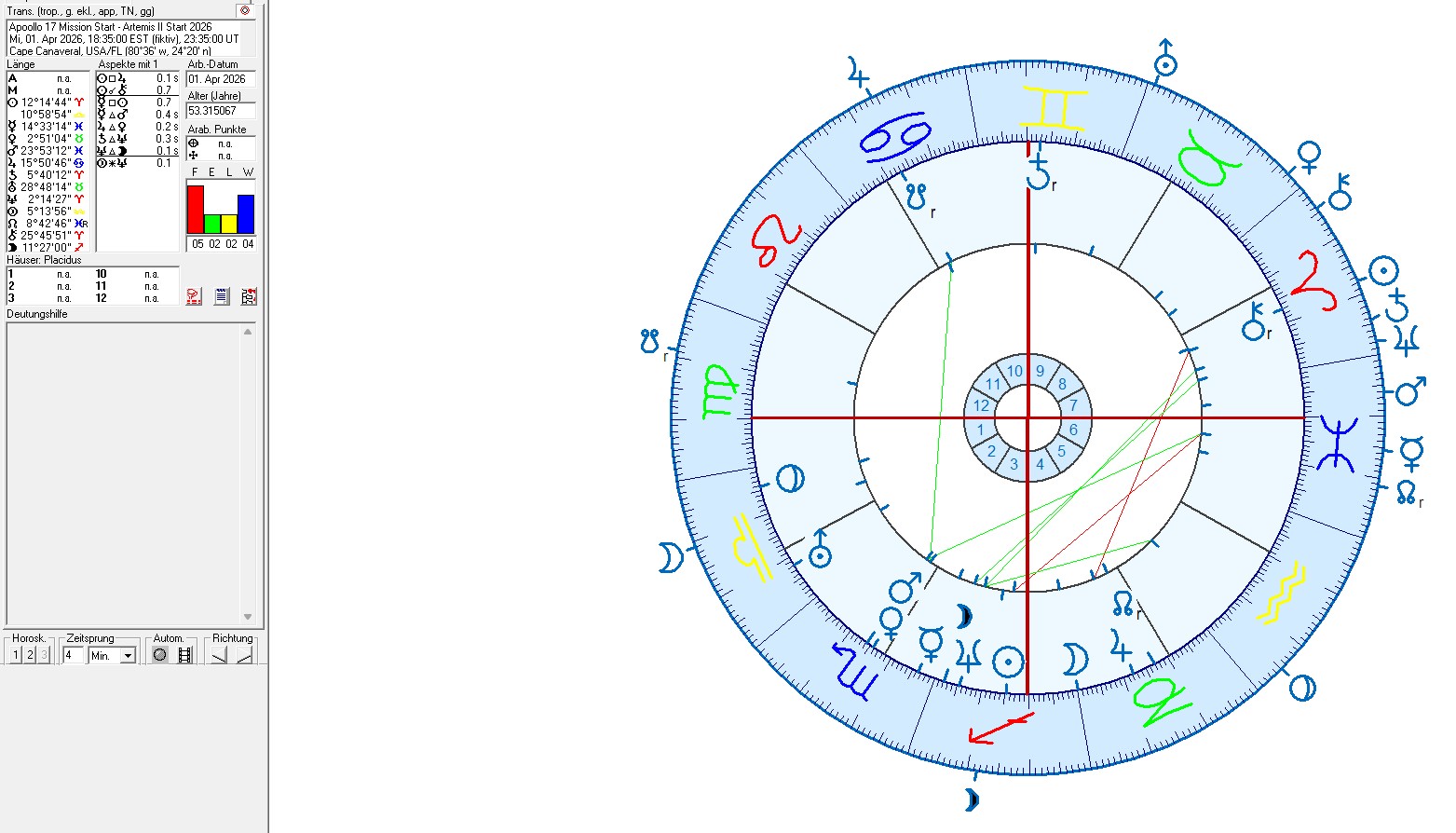
The Launch of Apollo 17 Mission:
- Pluto, as a flight container, was located in the 1st house, thus placing the spacecraft in an active position. .
- The Moon, which was actually visited, was located in the 4th house – which here signifies a real “grounding” on the Moon. The “home” (4th house) was reached by landing on the Moon.
- And since the lunar node, as the endpoint of the developmental path, also points to the 4th house, the purpose of the mission would have been achieved. The lunar node, as the target point at 16° Capricorn, a military degree, points to the significance of a kind of sporting military exercise to showcase the national cult.
- It is also fascinating that the 1972 Moon landing mission was launched with the Moon precisely on the degree of the winter solstice – so that the alignment with a degree of the zodiac was given, which in the hour system (house system) corresponds exactly to the archetype of Midheaven (MC).
- And since the lunar node, as the target point at 16° Capricorn, thus on a military degree, points to the significance of a kind of sporting military exercise for the demonstration of national cult. Sagittarius, the sign of orbits and orbits, occupies the 4th house and can be examined here in relation to the spaceship as a home or living room (4th house) in the moon’s orbit.
- Here, the position of Jupiter as the ruling planet of the 4th house in Sagittarius emphasizes this as a living room and home in orbit or the orbital movement. A sensational image for this
Comparison between the Launch of the Apollo 17 & Artemis II Missions:
- It is noteworthy that Artemis II, launched in 2026 as a continuation of Apollo 17, used Pluto as its launch container in an exact trine (4° Libra to 5° Aquarius) to its position from 1972.
- In contrast, for Artemis II, the Moon was in relation to the 1st house (conjunction with the Ascendant), while for Apollo 17, it was in the 4th house.
- Generally, the Medium Coe – the middle sky above the launch pad – indicates the sky directly above the launch site. For Apollo 17 and Artemis II, Saturn and Jupiter can be examined there as indicators that a vertical launch towards the sky took place. Both missions later tilted to enter Earth orbit.
For comparison: The horoscope for the launch of the Apollo 11 mission on July 16, 1969
Apollo 11 was the first successful mission to land humans on the Moon. The launch took place on July 16, 1969, at 9:32 a.m. local time (1:32 p.m. UT) from Cape Canaveral.
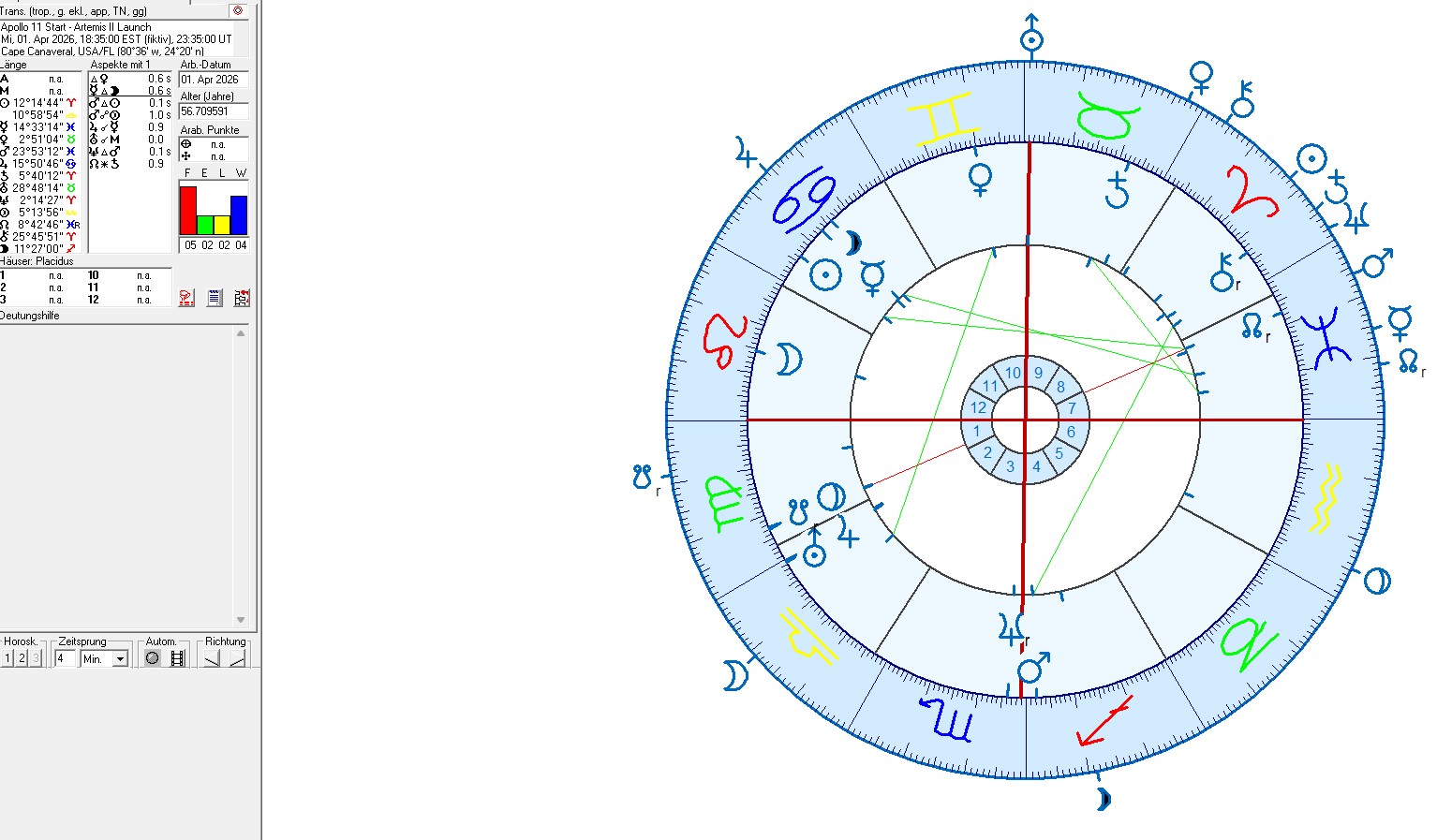
- Apollo 11 also had a target planet in the 10th house at launch: in this case, it was Venus, an indicator of rewards, possessions, personal fame, spoils, and profits, at 10° Gemini, the sign of technological development, communication, learning ability, mobility, paths, and vehicles.
- The following are among the various levels of interpretation for which this Venus position can be examined:
- A — Generally, Venus should be examined as an indicator of real earthly goals, or those that have a plausible connection to the mission. Venus in Gemini can thus be seen, among other things, as a source of profit resulting from investment in technological development.
- B — Since Venus in the 10th house also embodies the themes of sacrifice and prey in the public sphere, the Moon itself is also included here as a target for global competition.
- C — As the ruling planet of the Midheaven in Taurus, and therefore of the 10th house, Venus also represents the assertion of claims to the public sphere there. This circumstance is particularly significant in contemporary history because the competition for the first manned moon landing was specifically about rivalry with the gigantic Russian colonial empire.
- D— The MC at 29° Taurus, thus within the range of the most lucrative degrees of the zodiac, explained the issues transported by Venus as symbolizing the great potential for financial gains and territorial claims, which, although potentially in the distant future, were linked to claims to colonize the moon.
- Mars in the fire sign Sagittarius conjunct the IC: this aspect can be understood as a direct analogy to the ignition spark under the rocket at launch.
